
April Fool’s Day is celebrated annually on April 1st throughout the world. It is marked by people playing good- natured jokes and hoaxes on each other. It’s as popular today as it has ever been, these days even the media get involved, but its origins and roots stretch back thousands of years.
Almost every culture has a long-held tradition of what were known as ‘renewal festivals’ held at the start of April to celebrate the end of Winter and the return of Spring. These often involved forms of misrule and mayhem where people played pranks on friends and even their masters. Social order was inverted with children playing pranks on parents, servants on masters. Behaviour normally frowned upon such as lying, deception and playing pranks was tolerated but only until 12 midday when order is restored.
April’s Fool’s Day is believed to have evolved from festivals held as far back as Roman Times. The Romans celebrated a feast called ‘Saturnalia’ at the end of December. This involved lots of dancing, drinking, and exchanging of gifts. A king of misrule was elected who oversaw a temporary inversion of the normal social order, where slaves could pretend to mock or even rule their masters. This idea of a ‘lord of misrule’ and a fool who could question, and mock, his social betters was to become popularised in the U.K. by Shakespeare in the 16th Century.
In the Middle Ages festivals that have similarities to April Fool’s Day became popular. These included ‘Hoke Tide’ or Hock – Tide and involved men and women tying up strangers of the opposite sex and charging them a tax to be released. The tax was usually donated to the church.
Another festival ‘Shig- Shag’ (or Shick -Shack) was celebrated on May 20th when people put sprigs of Apple- Oak in their buttonholes to honour Charles II who was said to have hidden in an Oak – Apple tree to escape Cromwell. Anyone not wearing a sprig was mocked, or fooled, but only until midday.
The Town of Gottam (or Gotham) in Nottinghamshire also features in a comic tale about April 1st. In the 13th Century it was law that any road King John stepped on became public property. The citizens of Gottam did not want their road to become public property so they refused him entry. The furious King sent his soldiers to the town but when they arrived there they found the citizens engaged in such foolish activities as trying to drown fish and cage birds in pens with no roofs. The soldiers reported back that the Citizens of the town were mad so there was no point going anywhere near it.
Then in 1561 Flemish writer Edward De Dene who published a humorous poem about a nobleman planning to send his servant on a series of pointless ‘fool’s errands’ purely for the humour value of it. Ultimately the servant recognises that he is being pranked as an April Fool’s joke.
Another possible origin theory for the day comes from France in 1564 when the citizens were ordered to (under the Pope’s edict) reform their calendar by moving the end of the year from the end of March to the 1st of January. Those citizens who refused to change and still celebrated New Year between the 25th of March and April 1st were mocked and had pranks played on them. For example, pranksters would often stick paper fish to their victim’s backs and refer to them as ‘Poisson D’Avril’ (April Fish) which is still the French term for April 1st.
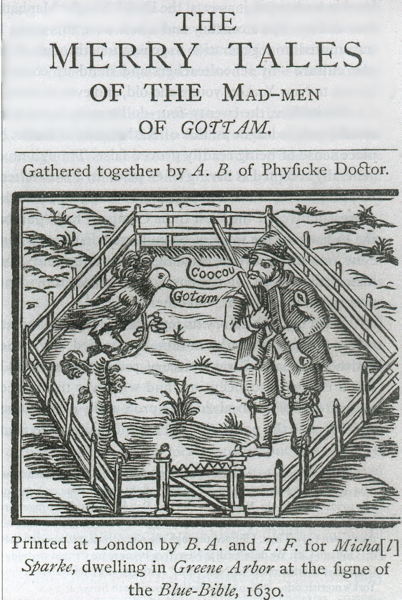
The Merry Tales of the Mad Men
The tradition of fooling and the character of ‘the fool’ hence became embedded in popular culture. Towards the end of the 16th and into the 17th Century the playwright William Shakespeare’s plays became very popular. Shakespeare included over 20 ‘fools’ in his work such as ‘The Fool’ in ‘King Lear’ who, under his guise as a fool, was able to point out the King’s errors and follies. Another character Falstaff in the King Henry IV plays was a ‘lord of misrule’ serving to challenge and undermine the nobility’s position through clowning and acting up.
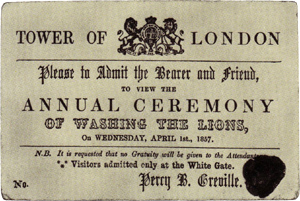
Fooling continued in the U.K. On April 1st, 1698, several people were tricked into going to the Tower of London to see the ‘lions being washed’ after a fake advert in a newspaper. This became a popular prank claiming at least a handful of victims each year.
The tradition of fooling continued to be recorded, for example when a writer wrote in the Gentleman’s magazine in April 1766 that there was,
‘A strange custom prevalent throughout the kingdom, of people making fools of one another on the 1st of April.’
In modern times the tradition of pranking people on 1st April has continued. The media, with its large audience, and the BBC in particular has played some great pranks on the nation as a whole. In 1957 on its ‘Panorama’ news show they appeared to show footage of the Swiss ‘spaghetti harvest’ being gathered in. The BBC was subsequently flooded with enquiries as to where people could buy the plants before they declared the hoax the next day.
Then in 1965 the BBC announced they were trialling a new type of technology where smell could be transmitted over the airwaves in so- called ‘Smell-o-vision’. Dozens of people contacted the BBC to say it had been a great success before the BBC again confirmed it was a hoax.
April fooling is seen as a great benefit to mental health, it brings people together and it gets them laughing which increases people’s well- being. Just remember if you’re planning any fooling, keep it light and good – natured and do it before 12 midday otherwise you become the fool!
By Mark Bateman